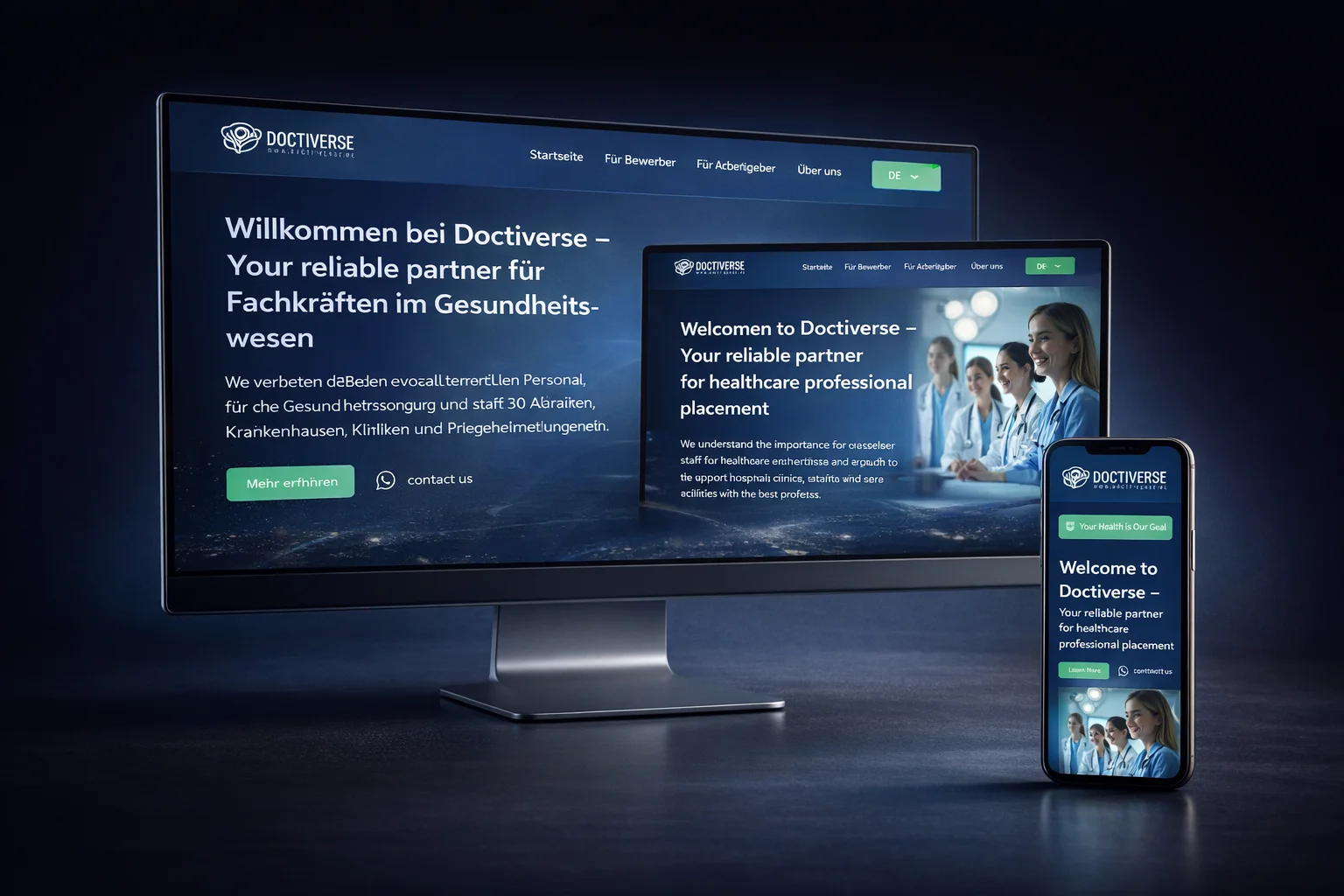
Doctiverse is a healthcare recruitment website connecting medical professionals with work and study opportunities in Germany. On the surface, it looks like a clean company website with candidate and employer sections. Underneath, it handles a two-step applicant workflow: a lightweight first contact, then a controlled follow-up where the candidate returns to provide documents and additional details through a private, time-limited form.
That second step is what separates it from a standard marketing site.
Core Capabilities
The public side presents the company to two audiences at once: medical professionals and employers. The site supports German, English, and Arabic, with localized URLs and translated content.
The candidate funnel starts with a short contact form. Name, email, phone number, optional message. Not every applicant should be forced into a long application on the first interaction. The detailed step happens only after the admin team reviews the case and decides to continue.
From the dashboard, admins send a follow-up message containing a signed link valid for seven days. On that page, the applicant adds details and uploads up to five files, including PDFs and images. Everything attaches to a single applicant record visible to the team inside the same system.
Architecture
Stack and structure
Doctiverse runs on Laravel 11 with a server-driven stack. Public site and internal workflow live in one codebase. Blade, Livewire, Alpine.js, Tailwind CSS, and Vite on the frontend. The interactive pieces are form-heavy, not dashboard widgets that need a JavaScript SPA, so this stack fits well.
Application layers
The application splits into two layers:
Public layer — the localized company website serving three languages with dedicated routes per locale.
Applicant layer — built around a
customersmodel, a relatedcustomer_documentsmodel, and an explicit status pipeline:new→follow_up_sent→additional_info_provided, withcompletedandcancelledfor the later stages.
Access security
The follow-up form is not exposed as a public route. Access goes through Laravel signed URLs with a seven-day expiration. When the candidate opens the link, the system restores the correct record into the session and serves the private form. For a workflow that involves document uploads, this is a better pattern than leaving the page openly accessible.
Document storage
Each uploaded file is tracked with:
Storage path under a customer-specific directory
Original filename, MIME type, and size
Linked database record, cleaned up on removal
Soft deletes are enabled on applicant records, and old deleted records are pruned after a year.
Admin Experience
The admin side runs on Filament. From the customer listing, the team can search, filter by date, inspect status, open the full record, review documents, and trigger the follow-up email — all without leaving the panel. No context-switching between email threads and shared folders.
Applicant data can also be exported in spreadsheet format: status, message content, additional details, document count. Useful when the team needs to review cases outside the dashboard.
Performance
The first applicant email is queued instead of sent inline with the form submission. Keeps the contact step lighter and avoids holding the request open on mail delivery. Livewire handles the interactive form flow. The rest of the site stays on standard Blade rendering.
One Laravel application covers everything here. Fewer systems, less duplication, cleaner ownership.
My Role
I designed and built both sides: the public trilingual website and the internal applicant pipeline. Contact flow, signed follow-up process, file handling, admin panel, status management, localized routing, and the email logic tying the two stages together.
This project sits between a company website and a recruitment ERP. A business-facing site that captures leads, qualifies them internally, and continues the process through a controlled follow-up layer. No disconnected tools.
CTA
If you need a Laravel website that does more than publish content, this is the kind of system I build. Company websites, landing pages, and business platforms where the public frontend ties directly into admin review, structured workflows, and operational follow-up.
Recruitment platforms, medical service websites, education intake systems. Any project where the first form submission is only the beginning.