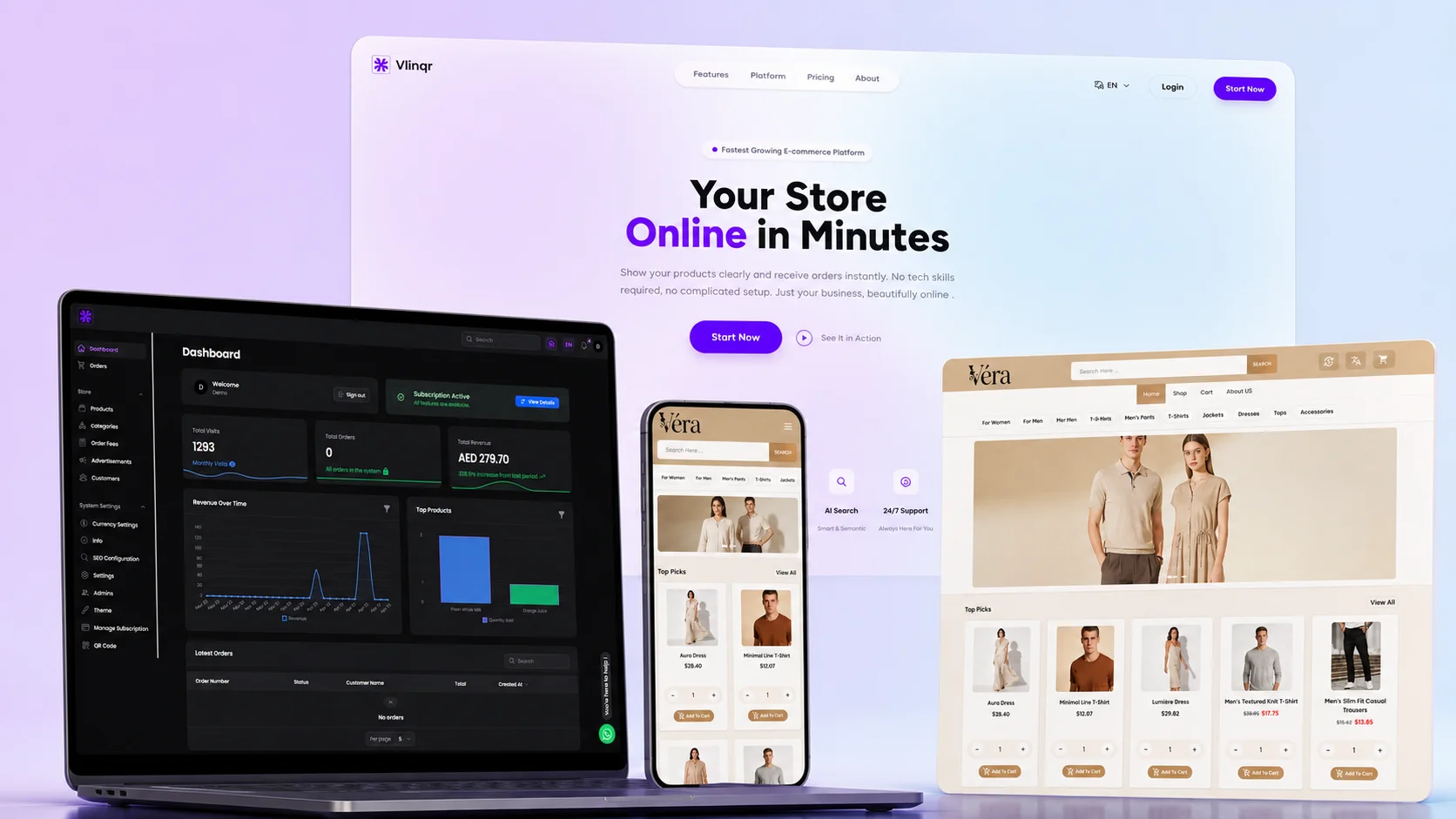
I’ve seen many eCommerce solutions fall into two categories: they’re either overly complex enterprise systems that are impossible for a small business to navigate, or "lite" builders that lack the core functionality needed to actually run a business.
I built Vlinqr to bridge that gap. It’s a production-ready SaaS platform that allows businesses to launch a fully functional store in minutes. The experience is designed to be straightforward for non-technical users, while the underlying system handles complexity behind the scenes.
Core Capabilities
Vlinqr is designed as a complete commerce system, covering everything required to run and scale an online store:
Store creation and onboarding
Multi-tenant infrastructure with secure data isolation
Subscription billing (Stripe + manual workflows)
AI-powered product discovery
Flexible ordering (checkout + WhatsApp)
Multi-language and RTL support
Admin tools for managing products, orders, customers, and teams
And continuously expanding with new features and improvements.
Core Architecture
Multi-Tenancy with PostgreSQL Row-Level Security
When designing a multi-tenant system, the "database-per-tenant" approach is common, but it can quickly become a maintenance nightmare as you scale—managing hundreds of migrations and provisioning overhead isn't ideal.
For Vlinqr, I chose a single-database architecture using PostgreSQL Row-Level Security (RLS). This was a deliberate engineering trade-off. By moving the isolation logic to the database layer itself, I achieved:
Bulletproof Security: Tenant isolation isn't just a filter in my Laravel code; it’s enforced by PostgreSQL. Even if there’s a bug in the application, data cannot leak between stores.
Operational Efficiency: One schema to migrate and one database to optimize, which makes scaling and backups significantly easier.
Instant Provisioning: New stores are live immediately without the overhead of creating new databases or running heavy scripts.
Search That Understands Intent
Standard keyword search (SQL LIKE) usually fails if a customer makes a typo or uses a synonym. I integrated Typesense to handle the search infrastructure. It provides millisecond response times and handles:
Typo Tolerance: It automatically corrects "iPhon" to "iPhone."
Semantic Results: It understands that a user searching for "phone" is looking for "smartphones."
Multi-Language/RTL: A critical requirement for the regional markets I support.
Subscription Billing — Stripe and Manual Workflows
Hybrid Billing: The platform handles global Stripe subscriptions but also includes manual "cash" workflows for regional clients who prefer bank transfers or physical payments.
WhatsApp-Based Ordering
Customers can place orders through a simplified flow that redirects to WhatsApp with pre-filled order details.
This removes the need for complex checkout systems and aligns with existing business workflows.
Admin Experience
Each store includes a fully featured dashboard built with Filament, customized well beyond the defaults.
Store & Products
Product Management — Full variant support (size, color, material) with independent pricing and SKU per variant. One-click variant generation from attribute combinations. Scheduled sale pricing per variant. Products are searchable by any attribute.
Theme Customization — Choose from ready-made storefront themes and customize variables (colors, fonts, styles) directly from the dashboard.
Storefront Advertisements — Each store manages its own independent set of advertisements by Uploading banner images..
Multi-Currency Support — Configure supported currencies from the dashboard. Customers can switch currency on the storefront.
Orders & Customers
Order Management — Status workflow tracking (new → processing → completed), order history, and basic invoicing. A configurable fees and taxes system lets store owners define rules as fixed amounts or percentages, with support for compound fees, conditional rules based on subtotal thresholds or item counts, and sort order control for the calculation sequence. Every applied fee is stored on the order for accurate invoicing.
New Order Notifications — Instant notification inside the dashboard when a new order arrives, plus browser push notifications so owners are alerted even when they're not on the dashboard. The entire team gets notified.
Customer Management — Customer profiles with contact details and address information, full order history per customer, search and filtering, with each store's customer list fully isolated.
Data Export — Export products, orders, and customers to CSV. Full record exports with all relevant fields, running in the background.
Team & Access
Team Roles & Permissions — Store owners invite team members with role-based permissions (Admin, Manager, Staff) . Granular controls determine who can manage orders, products, customers, and settings.
Growth Tools
SEO Tools — Google Search Console verification, automatic sitemap generation with one-click copy, auto-generated robots.txt, and full meta tag management.
Analytics — Sales overview, product performance insights, customer activity snapshots, and unique visitor tracking per month.
Custom QR Codes — Generate branded QR codes for store domains with real-time preview, full customization (colors, styles, patterns), and download as SVG or PNG.
Multi-Language System (RTL-First)
Vlinqr supports up to three languages per store, including full RTL support.
The interface is designed with RTL behavior in mind, ensuring proper layout and usability across languages.
Performance & Experience
The system is optimized to remain fast and responsive under real usage:
Cached storefronts for fast loading
Background jobs for heavy processing (exports, notifications, provisioning)
Progressive Web App (PWA) support — customers can install any store on their home screen for app-like access
Real-time and push notifications for the entire team
Tenant-aware caching, queue workers, and search indexes — ensuring complete isolation across every layer of the stack
The Roadmap (A Small Snapshot)
Vlinqr is a living project, and my backlog is honestly a bit overwhelming. While I have dozens of features planned, here is a small look at what I’m tackling next:
Integrated Merchant Payments: I’m building native, multi-gateway support so store owners can accept local and international payments without having to deal with the technical "plumbing" themselves.
The Vlinqr Marketplace: I’m designing a "clean core" plugin and theme architecture. Using a robust hook-and-filter system, I’ll be able to offer a premium ecosystem that extends the platform without touching the core multi-tenant logic.
Invisible Tracking & Compliance: Setting up pixels is a headache for most users. I’m implementing server-side integrations for Meta, TikTok, and GA4. This handles the heavy lifting of event tracking and Data Consent (v2) on the backend, so the store stays compliant without the owner touching a line of code.
This is just the tip of the iceberg, but these are the pieces that will turn Vlinqr from a store builder into a full-scale commerce ecosystem.
My Role
Product architecture and feature design
Multi-tenant system design and data isolation strategy
Backend development (Laravel ecosystem)
Frontend implementation (Livewire, Tailwind CSS)
Billing system (Stripe + manual cash workflows)
Search infrastructure and indexing strategy
Performance optimization, caching, and background jobs
Admin dashboard with Filament
Let’s Build Something Serious
If you are looking for a developer who prioritizes scalability, clean architecture, and real-world usability, I’d love to chat about how I can help with your next SaaS or multi-tenant project.